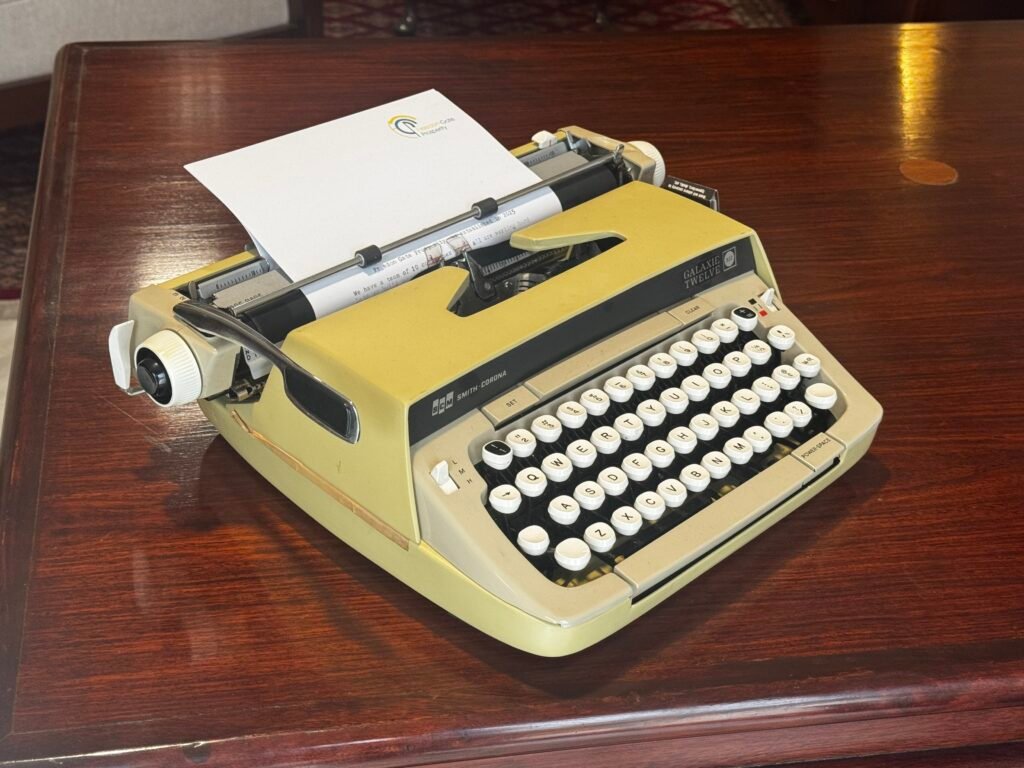
A few days ago, a manual typewriter was lying at my home, and I decided to place it on my office desk. I had bought it from Lahore some time ago, simply because I loved the feel of it. When I typed a page on it, it brought back a whole set of memories about how one simple tool changed the direction of my life.
This blog carries one message for young people: success demands hard work. Complaining does not take us forward. Struggle does. And Allah Almighty rewards sincere effort.
This story begins in the 1980s. I completed my matriculation in 1978, and soon after that, I decided to learn typing. My village, Meheen Mar, is in Kasur district. The nearest place where I could learn typing was Raiwind, about fifteen miles away.
In those days, roads were not paved, and travelling to Lahore often meant changing buses along the way. For me, the bicycle was the easiest option. For about four months, I travelled fifteen miles each way and practised typing for one hour daily.
I still remember my first lesson: ASDF. The teacher would set the speed, and we would be tested at the end. Over time, we were evaluated on both speed and accuracy: how much we typed in a fixed time and how many mistakes we made.
After a few months, I gathered two or three friends and suggested that we rent a typewriter. People trusted me, so we were able to rent one. I brought it home and kept it in our house.
Back then, in our village, most people had charpoys. Tables and chairs were rare. We did not have a proper typing table. A relative kindly offered a small coffee table. It was too low, so we placed two or three bricks under each side to raise it. That simple arrangement became my first real workstation.
With consistent practice, my typing improved a lot. At one point, I took a typing test and interview at the Employment Exchange Office in Kasur. The required speed was 25 words per minute. I produced 36 words per minute, with good accuracy.
When the result came in, the word ‘Selected’ was written at the top of my paper. At home, some people were surprised and did not believe it at first, because government jobs were often assumed to depend on connections. But after a few days, it was confirmed. That moment strengthened my belief in discipline and persistence.
Later, when my school received a typewriter in Urdu, I used the summer holidays to learn to type in Urdu as well. My speed became strong, around 40 words per minute. Urdu typing became especially useful in official work.
When salary bills and forms had to be prepared, typed documents looked neat and were easy to read. My handwriting was not very good, so typing helped me present my work professionally. It also helped me stand out and opened new doors.
In the District Education Office, city clerks were considered ‘high profile’ and often felt more competent than school clerks. One day, the District Education Officer asked his team to prepare long lists of teachers’ seniority in Urdu. The staff looked worried because they already had heavy workloads.
I told a colleague, ‘Please mention my name. I can do this work.’ My goal was simple: I wanted the District Education Officer to know me through my work.
He called me and said, ‘Son, this is difficult. It has to be done in Urdu, and these are long lists.’ I asked how much time we had. He said two months. I replied that I could do it in one month, then fifteen days, and finally in one week. They thought I was exaggerating, but the Superintendent was asked to assign me the task and observe.
At that time, we used stencils. You typed on the stencil and then used a cyclostyle machine with ink to make copies. Photocopying was either not common or very expensive.
I worked continuously for three days and three nights and completed the entire assignment. When I submitted it, the whole office was shocked. Even today, some colleagues still recall that moment and say, ‘Anwar did exactly what he promised.’
I remember another incident from the District Education Office. A telex arrived from Lahore with an urgent deadline for the next day. After Isha prayers and dinner, I returned to the office and started typing. By around 4:00 a.m., I was still working.
My room was slightly separate, near the side entrance. There were many mosquitoes. If I turned the fan on, the papers would fly. If I did not, it would have been hot. So I opened the door and continued typing.
The District Education Officer lived nearby and woke up early for prayer. Hearing the constant ‘tik-tik’ sound, he came quietly, later telling me he thought perhaps a jinn was in the office because typing at night seemed impossible. He stood behind my chair without me noticing, and then said, ‘Anwar, you worked all night. You should have told me if you needed help.’ He appreciated the effort, and in later meetings he often mentioned my work.
Later, I attended a meeting in Lahore linked to the Primary Education Project. There, an assignment was given to a colleague who said he would take two days. I said, ‘This is not much work. I can do it in two hours.’ They doubted it because it was in Urdu, but I insisted I could do it.
I was taken to the Project Director. I checked the machine, tightened it, cleaned it, and completed the work quickly. There were several stencils and forms to be typed, and I delivered them on time.
After that, they told me, ‘If you knew shorthand, we would keep you here on the steno typist seat.’ I said I did know shorthand and requested a test. A vacancy was available, and I passed the test.
I still remember one important date from that phase: 27 June 2003, when my orders were issued. Soon after, a policy decision upgraded stenographers to a higher pay scale. I had been planning to apply for a lower-grade clerical post, but by Allah’s will, the typewriter opened a better path.
Even some colleagues who had once opposed me later congratulated me and said, ‘We were against you, but you keep moving forward.’
Friends, my relationship with the typewriter is long, and that is why I have kept it to this day as a reminder. It helped me grow, gain respect, and find opportunities I did not expect.
My message is simple: never think your hard work will go to waste. It never does. Work with sincerity, build skills patiently, and keep your character strong. Inshallah, Allah will reward your efforts.

Muhammad Anwar is a governance and development leader with over three decades of experience in public policy and institutional leadership. As CEO of Freedom Gate Prosperity, he promotes democratic values, inclusive growth, climate resilience, and youth empowerment across Pakistan.
© 2026 Created with Muhammad Anwar